I seek the fire, the blue-green fire
of Oloa the snake dancer –
healer of our tribe, deliverer of daughters,
savior of lives, shaman of visions.
Spirit speaker Oloa, one of us and not one of us,
with us and always apart, we find her
by her fire when traces of dusk have vanished.
We follow the moon moth to Oloa’s fire.
Soleil broke into a sweat. She kept her breathing calm, but why sweating? The music was intense, but this wasn’t a usual reaction. Her life had been generally free of present danger; feeling it now, she didn’t understand it. Soleil couldn’t move or squeeze her hands, holding her grandmother’s and cousin’s. Her body was unresponsive to command. Tendrils of panic arose in her thoughts.
Something is wrong, nothing is cooking.
No song in her hut, no glamour of vines,
the beasts her friends all hide their faces
and make no sound.
An arrow! Our snake dancer
is no warrior, her weapons and power
are of another world, why does her
agate-tipped arrow wear blood?
Lysha begins calling the other warriors by name to join her. The music turns darker, urgency rising in tempo and timbre. Easing herself into a state of detachment, Soleil guessed she was having an adrenaline response with night terror paralysis. There was a distinct pulse in what felt like a physical place in her skull.
She would have spoken if she could, maybe to Margeaux, but she couldn’t manage even a quiet utterance. One by one, the other women singers were arriving in the piece. Together, they were discovering the scene of the crime. Finally, climbing a peak of terrific arpeggios, they screamed,
MURDER! She is slain. Fallen…
Soleil’s senses dimmed as though someone was squeezing her life in their fist. Her detached self understood that this wasn’t a mortal sensation – it had a distinctly neural quality, like the traces of iron in water. The animal core of her, however, was a rearing, frightened horse locked in and tied tight.
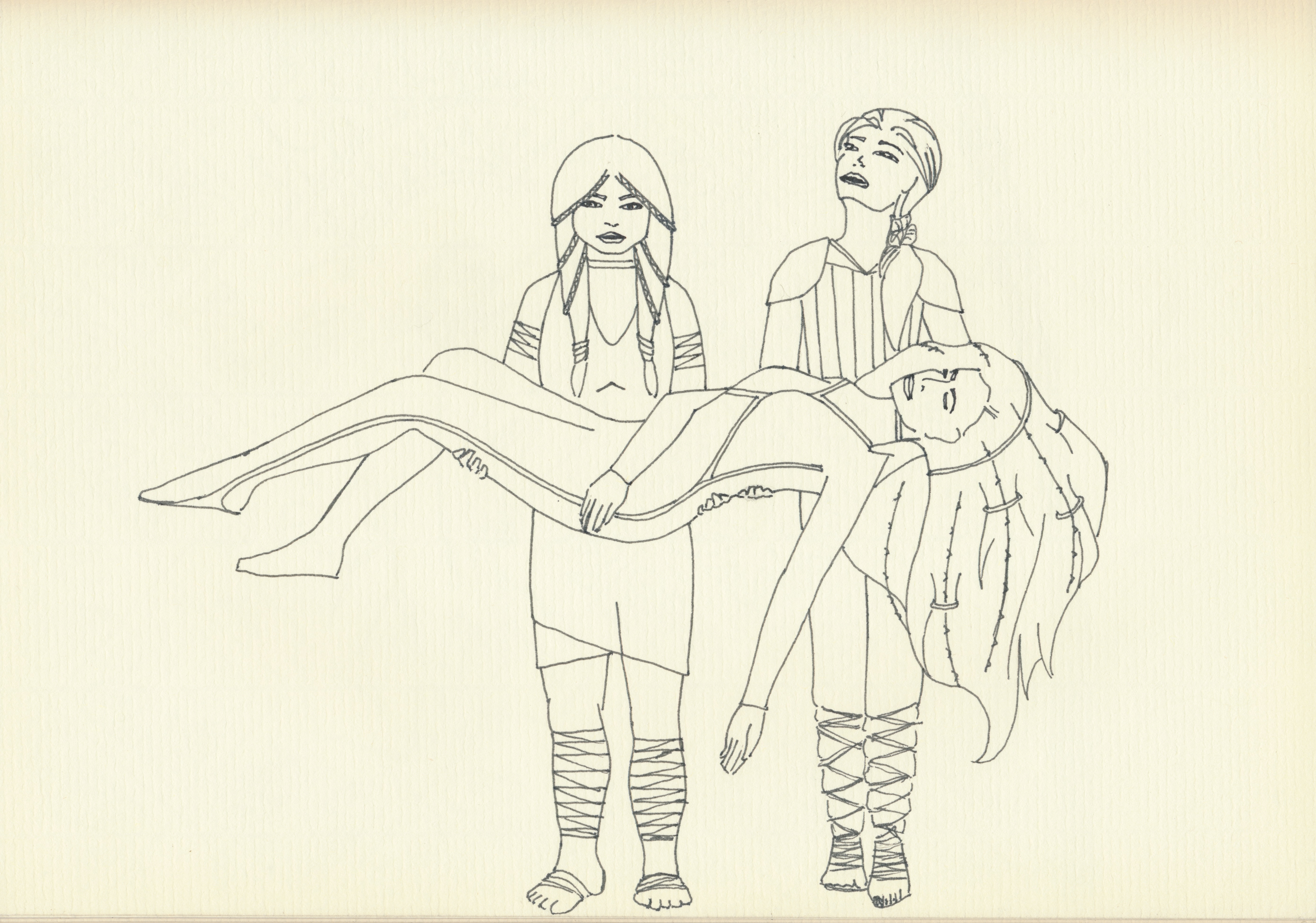
The dead shaman Oloa was carried out from backstage in the arms of Lysha and Neris. Soleil focused on her through pulses of blackness. It was a bright enough sight that it was something her mind could hold onto, even as it seemed somehow to be failing.
Traditionally, the shaman is a role of honor, the silent star of this piece. She emerges only this once in her full regalia, and she is already dead. This costume, not bound by any enduring or definite character, is often an homage to an ancestor or elder. On this stage, Oloa’s skin was black as night, her hair a voluminous dark fall including many strands of pulsating, soft rainbow light. This was bound in uncountable loose sections by loops glowing with the same light, as did the stripes down the sides of her fitted black bodysuit. Their dead shaman was a glowing, alien anachronism, lit up and supine as a martyr in neon; pitiful as a firefly’s last dance.
This assembly of glowing swoops and halos anchored Soleil’s vision. When she became certain that she could either cry out, or that her mind would cave to whatever was attacking it – the sensations fled, leaving the barest trace on her memory. As though she had eaten spicy food.
The four women onstage were now singing the memorial verse, setting the shaman onto a bier, covering her, and raising her up. Soleil’s mind was reflexively healing its trauma, covering its tracks, but she took note before it could erase them completely. Should mention this later, though to whom? Very unusual. The entire ensemble switched to percussion, beginning the battle verse.
We are a storm, the lightning suddenly
cleaving a tree in twain, the sudden fire
springing forth from its body, the fire that
takes the mountainside, the winds that
spread it and the driving rain that ends it.
Soleil rose to her feet with the rest of the front row. She was clapping. With bewildered sarcasm, she noted that her hands and feet were now working just fine. She smiled, and all the cameras looked at her.
 Bones of Starlight 3 : Greater Beyond