Equinox Watershed Seattle Georgetown Primal Spiral & Friday Harbor 1st Block Primal Spiral creative studio evolved through its reactivation in 2025, starting up for a season and some at Make.Shift in Bellingham. I accepted an offer for studio space in Seattle Georgetown with the Equinox Collective Watershed arts neighborhood project, and transferred my Bellingham functions here. I also reopened in Friday Harbor, my island town address, on the first block from the ferry at [Parking Gate] 3. So now there’s Primal Spiral Seattle & Primal Spiral Friday Harbor, and at these places I can forge ahead with new writing, and receive creative company.
Seattle WorldCon 2025 Seattle WorldCon was a culmination of years of participation and contribution, and I’m so proud of my local SFF and writing community for hosting a world-class event that brought many of the amazing authors, artists, publishers, and fans that I’ve been hobnobbing with for the previous decade to our very own city neighborhood. Along with speaking on some fabulous panels, I hosted my first WorldCon dealer’s table, which was a cheery scene, and invited people to my Midnight Write-In Cacao & Tea Social Hour at Primal Spiral Georgetown.
ELASIEL176CE: 12/21/25 print date This story came together from ideas and processes that began some time ago, and was ready to step forth for publication after Bones of Starlight; I consider it part of a larger book, titled alwaysbeeneverwas, with other intertwined mythologies. In this separate photoessay-constructed form, it’s a Fantasy New Age Multiple Life Philosophy Erotica; for sale to ages 18+, only as an additional purchase to any other volume by the author, in print through limited in-person/author-direct distribution; with a look to a later-upcoming online release on: Only Fans.
I renewed with SFWA through 2026 I’m also renewed with the Science Fiction and Fantasy Writers Association through 2026! Cheers to my second year in the professionals’ formal league.
photo credits, top-bottom: 1. Jason Ruvelson; background painting wall treatment mural by ELE Eva L. Elasigue 2. Adrian 3. stadium neighbor 4. Myrrh Larsen 5. selfie by the author
There were a few items of provender sitting on a kerchief in the corner. In the middle of a room cleared of rotted furniture, Raev sat cross-legged. He cradled the glowing fist-sized mixed phronium ingot in the crook of his open hand, against his abdomen. The set of his mouth was tranquil, but his brow was slightly furrowed over closed eyes.
He flipped from thought to thought, wondering what he should do and where he should be. Raev was holding a betweenlight meditation, acknowledging good and bad, while it was twilight outside. The glow of the phronium was stronger in contrast; he also meditated centrally on this new object. What to do with this undoubtedly unique conglomeration of elements?
There was also everything he had embedded within him, and without particular ambition, he subtly continued testing the connections and reactions it created with this new piece. He thought of it as a potentiator, something that might be able to accomplish the unguessable.
Raev searched along the pathways that lead from his realms of existence. He had a kind of broadened access to dimensions humans don’t often frequent, and maybe somewhere in there he could find a cue as to where he should place himself, out of the way of ultimate triumph.
He was experiencing simultaneity, his presence distributed between several places, when he abruptly felt seen. When the two presences found they were able to verbalize, they sounded like each other in some essential way.
something in between searching without needing active in stillness unique – I know this power. mixed feelings about it, but it does not fear me many more fear me – I could leave them behind for the rest of the universe, though this is interesting perhaps, it is I who seeks peace
Oh – you’re familiar, fancy finding you here; nowhere in particular I seek nothing in particular, other than my ultimate destiny, which awaits no matter where I turn I could spend time with you if such be time I’m not sure we’ve properly met, though I know who you are. as long as I can breathe, after a fashion, I’ll be fine in your world
I would enjoy some conversation; this could be important, though it need not be. simple company sounds good there is a place we could rest asking little or doing much I can bring you through, if you reach out to me I will not hurt you if you will not hurt me this will be fine for now we can speak of the endings you think upon
Raev did reach out to Acamar, and in a flash of dark matter scales, the house and the planet were again devoid of human life.
I want to cross-post this interview here, for its relevance to Bones of Starlight’s life as an online serialization. Without serializing, Bones of Starlight may not have come this far, or it may have become a very different thing. Twice at least, serializing online saved the amount of work that had been achieved when disaster struck my equipment. A couple key influences brought me around to serializing Bones of Starlight; firstly Creative Commons and their flexible creator’s rights work that allows me to reserve rights to correct attribution while allowing my work to be broadcast by others and myself over the open web and world – but I’d also heard about it being done once before, with this really wacky story that I first saw as a movie, which turned from a popular blog into a new and celebrated writing career. That was John Dies At The End, a interdimensional psychedelic save-the-world misadventure that had me cracking up through my first watch. I got a copy of it from my video rental job, and heard the legend in a living room. The author, David Wong, is also actually named Jason Pargin. He did this interview with me over email, in pre-release of the fourth John Dies At The End novel: If This Book Exists, You’re In The Wrong Universe (coming out in October). Enjoy!
(The Martian also serialized online, and I learned about that while already underway with my first book’s continuous release.)
–
So a publisher picked you up eventually, and then they edited. What was that like, did you and your readers mind the changes much?
Editing has always been painless for me, but I have no idea if that experience is typical.
Like I’ve actually never had an editor demand changes, it’s always more of a collaborative thing where they explain issues and you kind of work together to figure out the best way to fix them. But I also had some leverage during that process, too. By the time I was working with an editor for the 2009 St. Martin’s release of JDatE, the online version had already gone viral several years before (some 75,000 readers saw it for free online starting around 2000) and I’d self-published and sold a substantial number of print-on-demand copies (something like 6,000). So the one time they did suggest a big change (cutting a certain chapter) I argued that existing fans would see this as an incomplete edition, and would rebel. And those existing fans were the ones we were depending on to build hype for the hardcover release and leave reviews etc. But it wasn’t some huge argument, they suggested it, I explained why I didn’t want to do the change, that was the end of it.
Every other suggestion from the editor was less substantial but always made the book better (pointing out plot or continuity errors, incorrect phrasing, confusing action descriptions, quoting copyrighted song lyrics – stuff you can’t really argue with).
How many groans were there when they took the serialized story offline? Did you feel like that changed your way of relating to your audience?
Well, there’s some additional context there. Completely aside from the book, I was a mildly famous blogger starting in the late 90s (not that I made any money from it, but I had a lot of readers and was pretty well known-among other online creators). So I gave my work away for free for years and what you find is that the most passionate fans do feel some sense of entitlement, even when they’re getting all of the content for free (for example, there were constant complaints about the banner ads, even though they barely covered my costs and in no way paid me for my time/work).
I don’t even mean that in a negative way. It’s just the way it is, fans will always demand more, so any change (say, if I switched the publication schedule to be less frequent, or took a few weeks off, or ran something they disagreed with) there would be loud complaints and messages implying that I owed them now, that I needed to make up for my mistake, even though again they’d paid nothing and about a third of them were using ad blockers. They just assumed that because I was so widely read, I was surely getting rich off it thanks to them, and that I thus owed them.
So the angry messages that came from me pulling the free version of the novel offline were there, but those kind of messages are always there – if not about that, then people complaining that the site was slow, or that they were getting error messages on the forum, etc. Often I’d have to pull old articles because something would be broken with the formatting (due to an update to web browsers or Flash version or whatever) and as soon as it came down, a bunch of angry people would claim it was their favorite article and why didn’t I pour hours into fixing it instead.
It doesn’t take many years of that before you kind of grow numb to the complaints. Not that you don’t care or stop listening to feedback, but that you realize that’s just kind of the background noise of your life and you don’t let it cause you stress if you know the change was one you had to make. Complaints are just the noise an audience makes sometimes.
What has novel publishing been like since, are you still with the same publisher?
Same publisher, same editor. What happened was the hardcover of JDatE sold pretty well (I earned back my advance in seven days) and then they signed me to do a sequel, which came out right when the movie did in 2012, so the hype/press around the movie put the second book on the NYT bestseller list. After that, the publisher signed me to a multi-book deal for a legitimately huge amount of money. I’m on a schedule where I publish a novel every two years and it takes me every bit of that time to write one, that’s just the speed at which ideas occur to me. Still, I had a full-time job separate from novel writing until early 2020 at Cracked, and had intended to always do that. Things just didn’t work out that way so I’m writing novels full time but that’s not by choice. I assume I’ll get another day job at some point.
Is serializing something you only did that once, would you again? Why did you serialize in the first place? You were working in insurance, right.
Here’s where I’m worried my advice might not be relevant in 2022 or, more importantly, to someone trying to start a paid writing career. In the late 90s to early 2000s, I was working two office jobs (doing data entry for an insurance company and filing/billing for a law office, jobs I was just getting through a temp agency) and was blogging on the side with some hopes that I could get popular enough to turn it into a side job via banner ad revenue (that never happened). The first “John Dies at the End” post wasn’t called that, it was just another blog post, one I did for Halloween in I think 2000, a standalone haunted house story in which “David” and his friend investigate a haunting and get chased around by meat.
Back then, the blog was just any kind of humor essay I felt like writing, sometimes reviews or fake news stories, other times comedic narratives starring David and John. So this Halloween post wasn’t out of character, occasionally I’d just have a funny story starring these two guys, and the format of the site was that each story would start off with some kind of normal setup and then wind up somewhere extremely stupid.
That next Halloween, leading up to the holiday people started asking when the “sequel” to the previous year’s scary post would be up, and that was the first time I realized I was going to have to write another one. So those stories became an annual Halloween tradition until I wound up with something novel-length. Then in 2005 or so I put them all together with their own navigation and section of the site, and heavily edited the whole thing, going back and retconning changes and adding foreshadowing to events I wrote later, so that it all appeared to be on purpose. It was written over the course of five years and those posts were basically my fiction writing school; I’d barely done it before that. I think I’d written a total of two short stories in my entire life prior to 1999. But I’d written plenty of silly fiction as part of the blog.
But I can’t make this clear enough: I never aspired to be a full time novelist, and actually never thought I’d like doing that as a job. I have never shopped for an agent or publisher, I literally don’t know what that process looks like. I’ve never researched the industry to find out what’s hot or what genres are selling, I’ve never kept up with trends or looked into the best ways to get a foot in the door, it all just happened to me mostly on accident (more on that later).
I was super happy for you to hear that you were subsequently hired to write for Cracked, and it looks like your career continues smoothly.
Yeah I got the Cracked job in 2007 but that was due to a whole bunch of good luck and circumstance (there were more famous writers up for the job, but I was friends with the guy who had it before me and his reference went a long way). It was absolutely a dream job that any friend of mine would kill to have (working from home writing blog posts full time, with benefits). But when I got hired, I assumed it wouldn’t last more than 1-2 years, dotcom startups had a bad reputation for flaming out and I was taking a huge risk by taking the Cracked job and quitting my much more secure insurance job. My rationale was that if nothing else, it would build my resume and allow me to get other writing jobs in the future.
Instead, it was a huge success for the first several years. Then around 2014 the industry started to change and in 2017 the site was sold to a new company, who fired pretty much the entire staff (aside from me) less than a year later. But we were always understaffed, I think I averaged 100 hours a week for five straight years, putting in at least some hours on every single weekend, holiday and sick day.
I held on until 2020 but it was a steady process of budget cuts and layoffs and constantly feeling like every day would be my last. I left in early 2020 because they basically eliminated my position and I just didn’t feel like pivoting to a new one, because at that point the years of stress had taken a massive toll on my health (I still need medication to digest food normally). I only recently stopped having stress dreams that I’d overslept and missed some important meeting or deadline.
Do you now find it easy to write a book in secret and release it the traditional way, now that you have industry support?
The industry support is great, but that extends to them working with bookstores to make sure the book gets stocked, and doing some of the promotion. The rest of the promotion is up to me, and it’s literally a full time job (this is true of any author). In order to maintain a network of connected readers I can announce books to, I maintain three Facebook pages, a Twitter, an Instagram, a Mailchimp newsletter, a Substack blog/newsletter, a Goodreads page, a website and a YouTube account:
I maintain all of those myself, for the most part. I also do publicity year-round, in 2021 I guested on about 32 hours of podcasts; that’s all unpaid, it’s purely for book publicity:
The video trailers I release for my books are arranged entirely on my end, for the last Zoey book I hired a production company here in town, writing the script myself, approving every aspect of the production down to the props, and paying for every bit of it out-of-pocket:
For each book, I’ll spend about $20,000-$25,000 of my own money on promotion, plus several thousand hours of my own labor in updating socials or doing guest posts. So the industry support is amazing, I know every author would kill for it, but I can’t emphasize enough that my life is 80% publicity/promotion and 20% book writing.
Is serializing something you only did that once, would you again?
Well the issue is that I don’t actually write my novels in order, I do an outline and frequently skip ahead to write some part I feel more like working on that day. The process of circling back to change the beginning (to add foreshadowing or to set up payoffs) continues right up to the end of the editing process. So the only way I’d release something in serial form today is if I wrote and edited the entire thing, and then released it a chunk at a time. And at the moment I don’t know that there’d be any advantage to that. But if I was starting my career new, I might consider it (but even then would probably release it primarily as an audiobook or podcast, with the text version as like a bonus for those who prefer it).
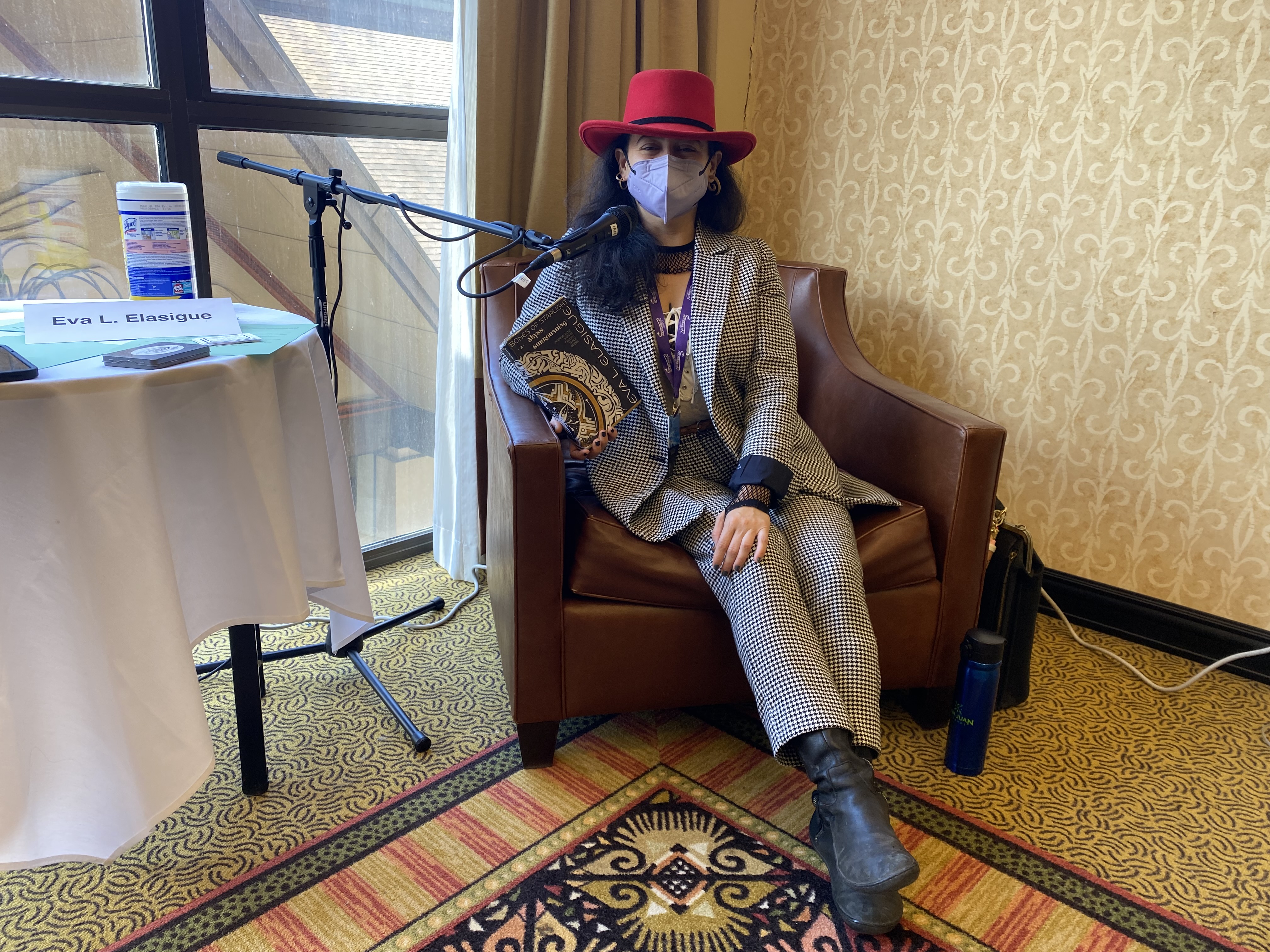
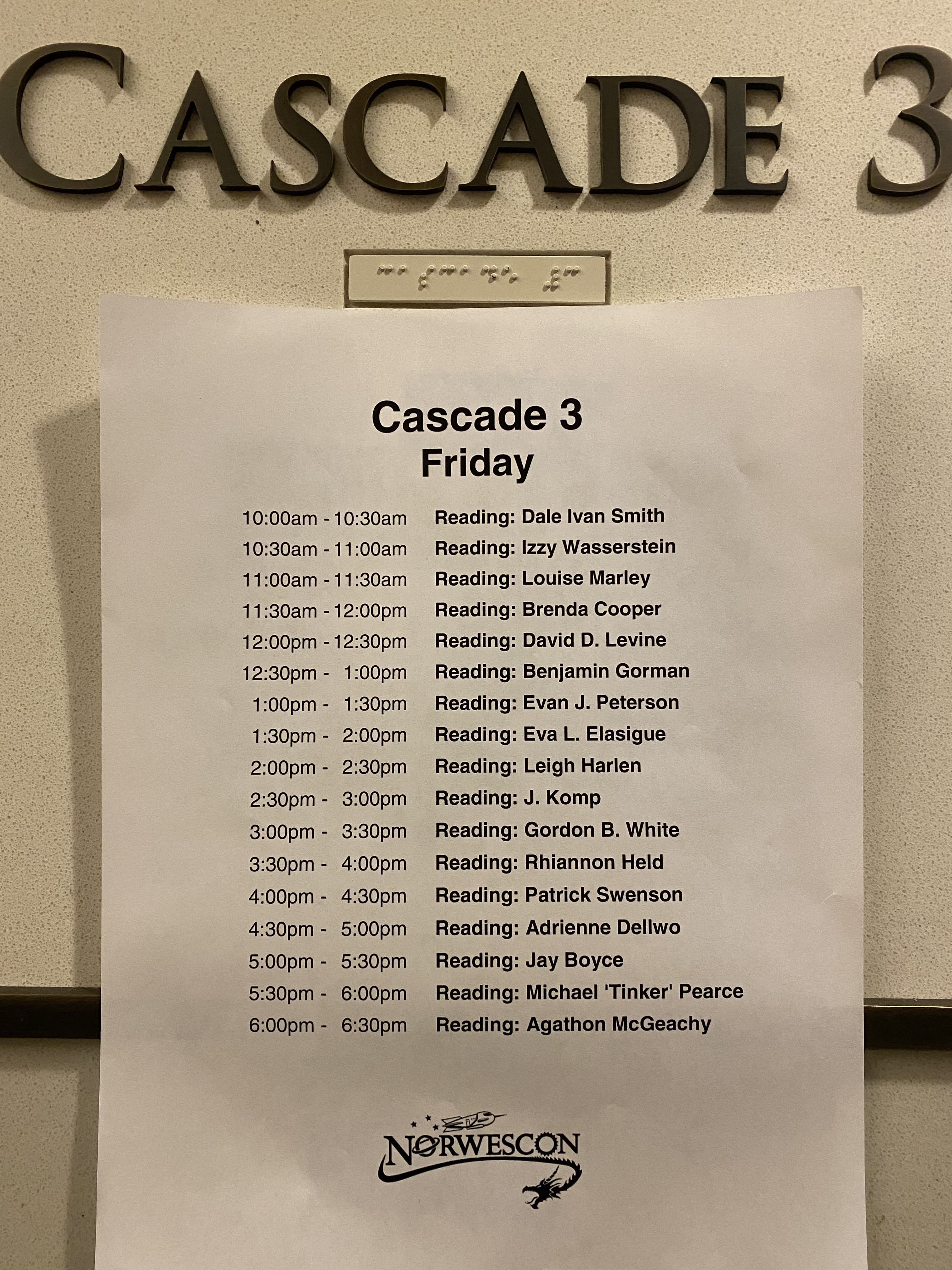
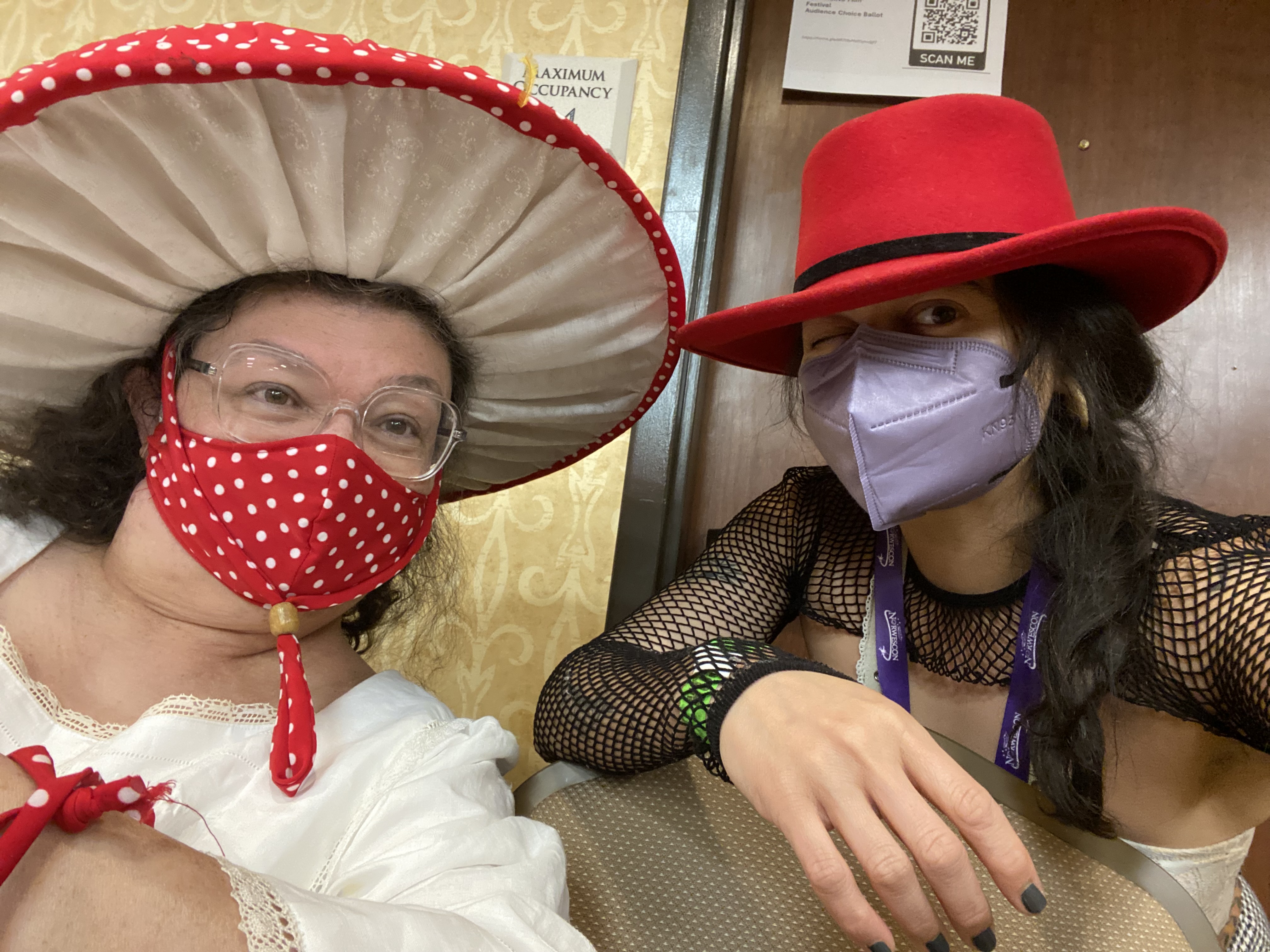
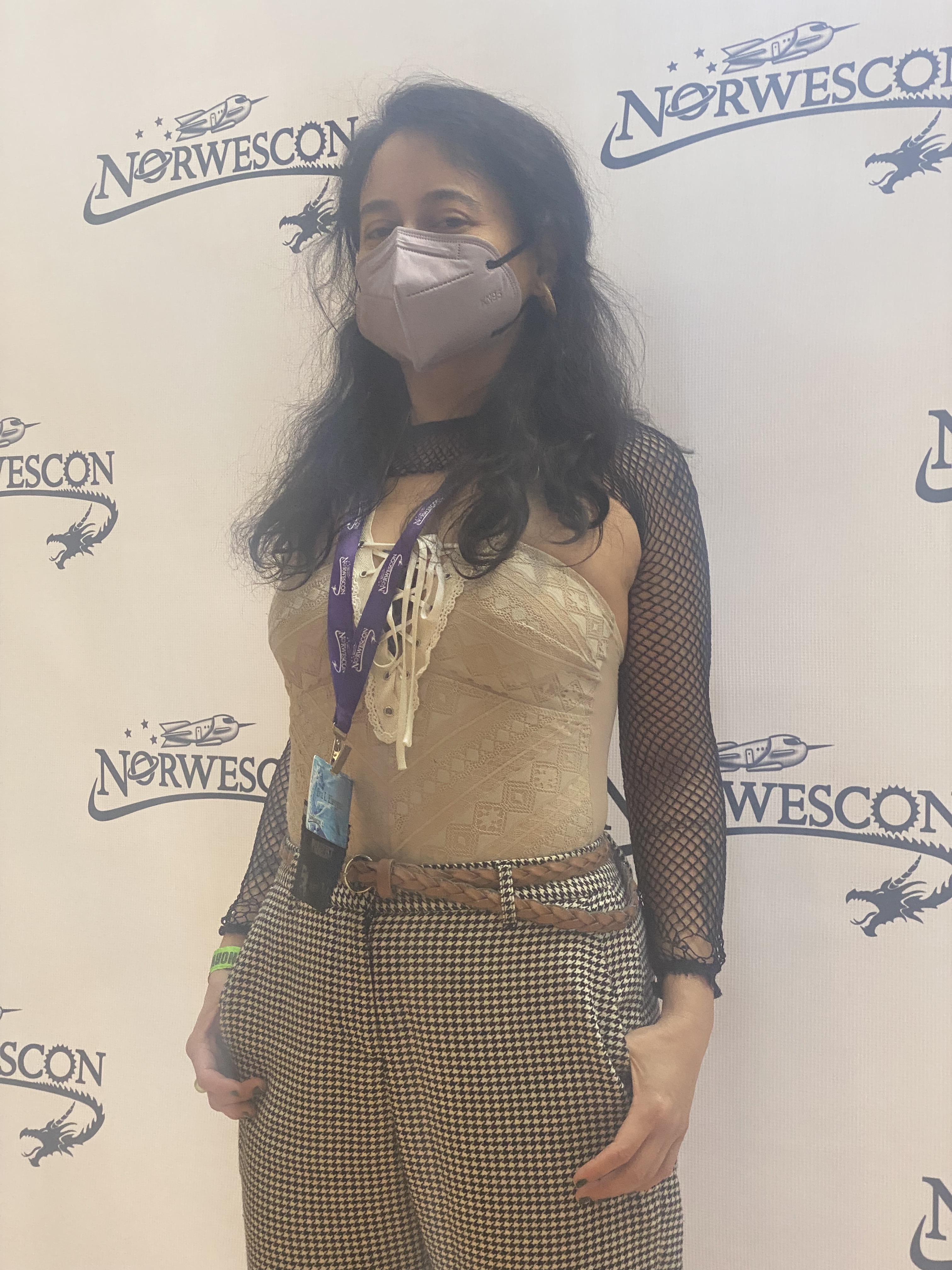
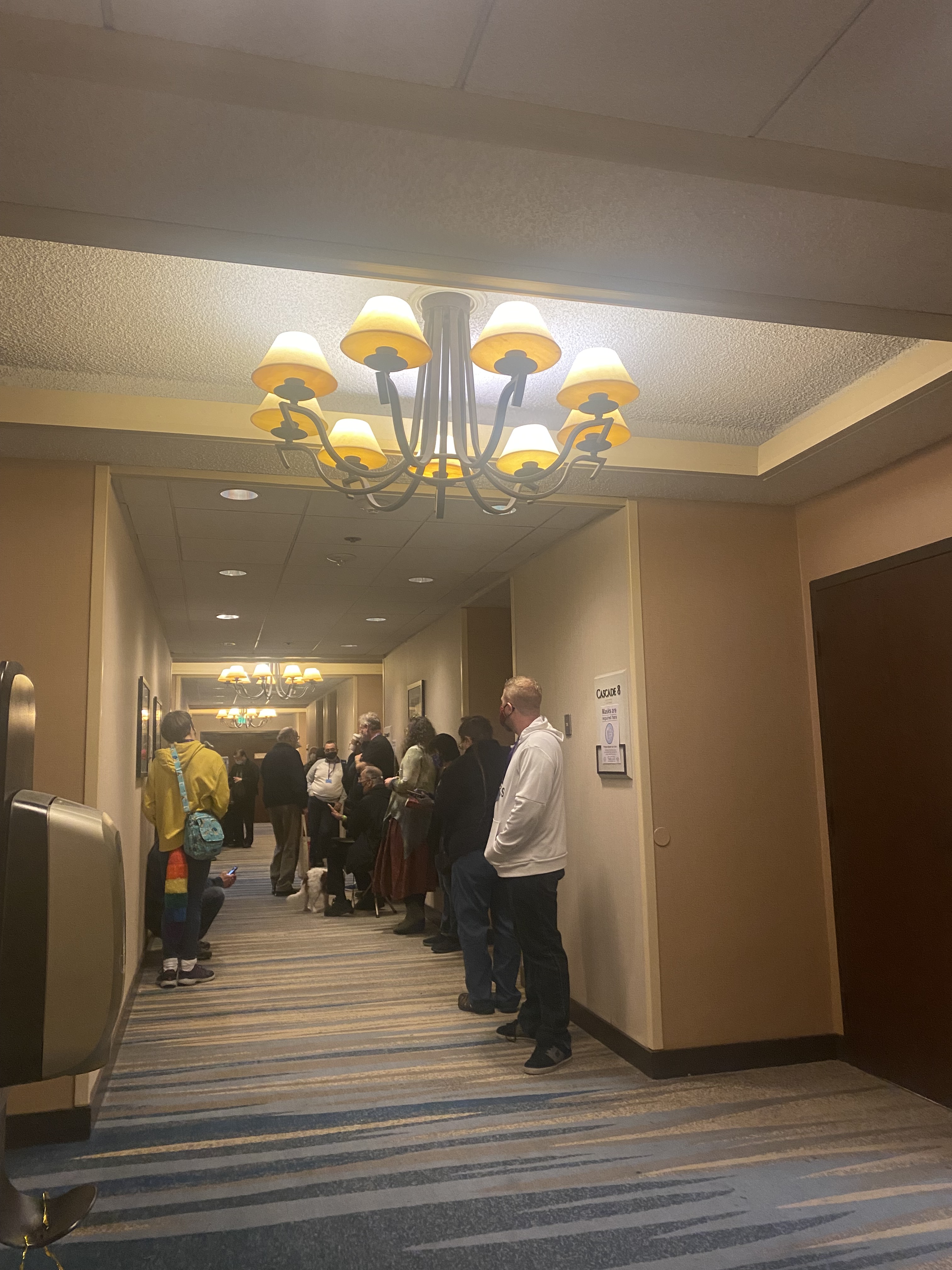
I’m in full swing at Norwescon 44, a return to the in-person convention. It’s great seeing the familiar Seattle and beyond bunch, with the new faces of course, despite being capped at a lower than usual number. There’s still a virtual component by donation, with unlimited invitation. My panel schedule is listed below.
SCHEDULE
Thursday Is Space Really the Old West? 3:00pm – 4:00pm @ Cascade 11 Dr. Sean Robinson (M), Gabe (G.S.) Denning, Eva L. Elasigue
Creating Diverse Fantasy Cultures 4:00pm – 5:00pm @ Cascade 9 & 10 K Tempest Bradford (M), Amanda Hamon, Eva L. Elasigue
Friday The Changing Perceptions of AI in Science Fiction 10:00am – 11:00am @ Cascade 9 & 10 David D. Levine (M), Dr. Sean Robinson, Eva L. Elasigue
Reading: Eva L. Elasigue 1:30pm – 2:00pm @ Cascade 3 Eva L. Elasigue (M)
The Bi Erasure, Invalidation, and Trauma Connection 7:00pm – 8:00pm @ Cascade 7 & 8 Torrey Stenmark (M), Sheye Anne Blaze, Sar Surmick, Eva L. Elasigue
Saturday Including Marginalized Creatives 10:00am – 11:00am @ Olympic 3 Xander Odell (M), Eva L. Elasigue, Annie Carl, Benjamin Gorman
Autograph Session 2 11:00am – 12:00pm @ Evergreen 1&2 Carol Berg, Brenda Cooper, Rhiannon Held, Patrick Swenson, Joseph Malik, Joseph Brassey, Eva L. Elasigue, Louise Marley, Mikko Azul, Connor Alexander, Mike Jack Stoumbos, Nancy Kress, David D. Levine, Lydia K. Valentine, Cat Rambo, Rob Carlos, Jeff Sturgeon
Worldbuilding: Geology 4:00pm – 5:00pm @ Cascade 5 & 6 Colette Breshears (M), Michael ‘Tinker’ Pearce, James “Pigeon” Fielder, Ph.D., Eva L. Elasigue
Join the Resistance 5:00pm – 6:00pm @ Cascade 7 & 8 David D. Levine (M), Carol Berg, Eva L. Elasigue, Shannon Anthony
Sunday Writing Hacks to Crack Writers Block and Un-stall Stories 10:00am – 11:00am @ Olympic 3 Eva L. Elasigue (M), Dale Ivan Smith, Gordon B. White, Randy Henderson
It’s Gettin’ Real in that Solar System 11:00am – 12:00pm @ Cascade 11 Eva L. Elasigue (M), David D. Levine, Rhiannon Held
Scum and Villainy in Science Fiction 1:00pm – 2:00pm @ Cascade 7 & 8 Kris ‘Pepper’ Hambrick (M), Shweta Adhyam, Eva L. Elasigue
“What do these rumors tell of?” King Vario grabbed onto the next topic.
“They’re on the crest of a wave of communication flotsam that’s hard to track, because our usual channels are shut down the same way theirs are. There are moments of coherence that allow glimpses of corroboration.”
“We have newly designed layers of surveillance working now, out through the net prism. Are you working with this data?” asked King Vario.
“No, I’m intentionally looking elsewhere. The usual rays of the prism are heavily fractured, and I won’t get more from that than you can yourself.”
“Do you have records and files?”
“What I have is my report. Information of this kind is strange and different where I’m looking. It’s harder to capture.” The official refrained from trotting out all the gory details of mafunctioning screen photo, impenetrable and unmodifiable code, all recordings blackout. It would not be of interest, it was instantly boring information, and of dubious credulity even to the most knowledgable. Raving to the uninitiated. “In short summary, there is a concerted cadre of establishment attackers, explaining why this situation is, uh,” Roznmyk touched her face, “actually the fault of our government.” The newest packet dropped just yesterday, and it has usually taken a few days for people to readjust their theories. Roznmyk knew people were working on it without her. They were highly motivated – not just by boredom, but also by rewards of confirming information, seeded strategically or serendipitously. The packets were often signed in disappearing ink, or the code equivalent thereof, from names who had built credibility, despite possibly being from among the enemies throttling entire neighborhoods.


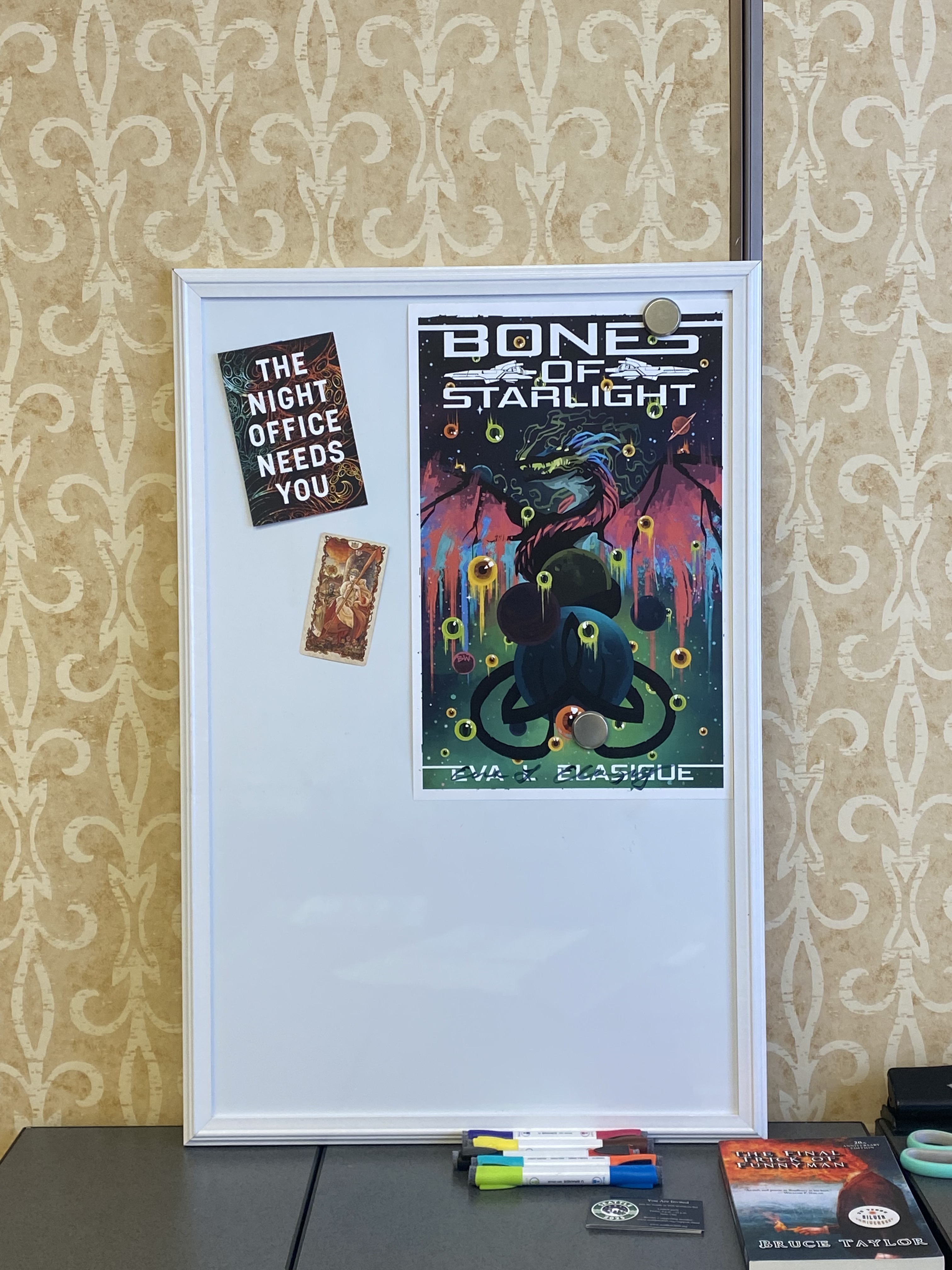
 Bones of Starlight 3 : Greater Beyond